Cancer Doesn’t Excuse You From Capitalism
Since 2023, people have asked me the same question over and over - “Why are you still working?” To them, I want to say: “I’ll stop working right this second if you’d like to cover my medical bills - all a few hundred thousand dollars of them. Deal?” Some well-wishers have asked if we should start a GoFundMe, others want to know my prognosis, how long I’ll be alive - perhaps so they can line up their heartfelt RIP stories and annual #ThrowbackThursday tributes. A few even asked for souvenirs, as if I were already halfway gone.
I would tell those people to kindly take a hike. Because the truth is, the American healthcare system is beautifully broken. It will keep me alive by getting me the optimum healthcare only as long as I keep showing up for my 9-to-5, prioritizing productivity over rest, and feeding the machine that funds my survival.
Even a healthy person struggles to survive a corporate job. Add chemotherapy to the mix, and the game is rigged from the start. There’s the bone-deep fatigue, the “chemo brain” that fogs every thought, the taste of metal that lingers for days. And then there’s the quiet terror — of layoffs, of insurance lapses, of a life that stops being affordable the moment you stop working. Corporate culture isn’t a sanctuary of compassion; it’s a treadmill where slowing down means falling off. And in this economy, with its layoffs, wars, and uncertain markets, cancer doesn’t excuse you from capitalism. So yes, I’m still working. Not because I’m strong. Not because I’m brave. But because survival in America requires a paycheck.
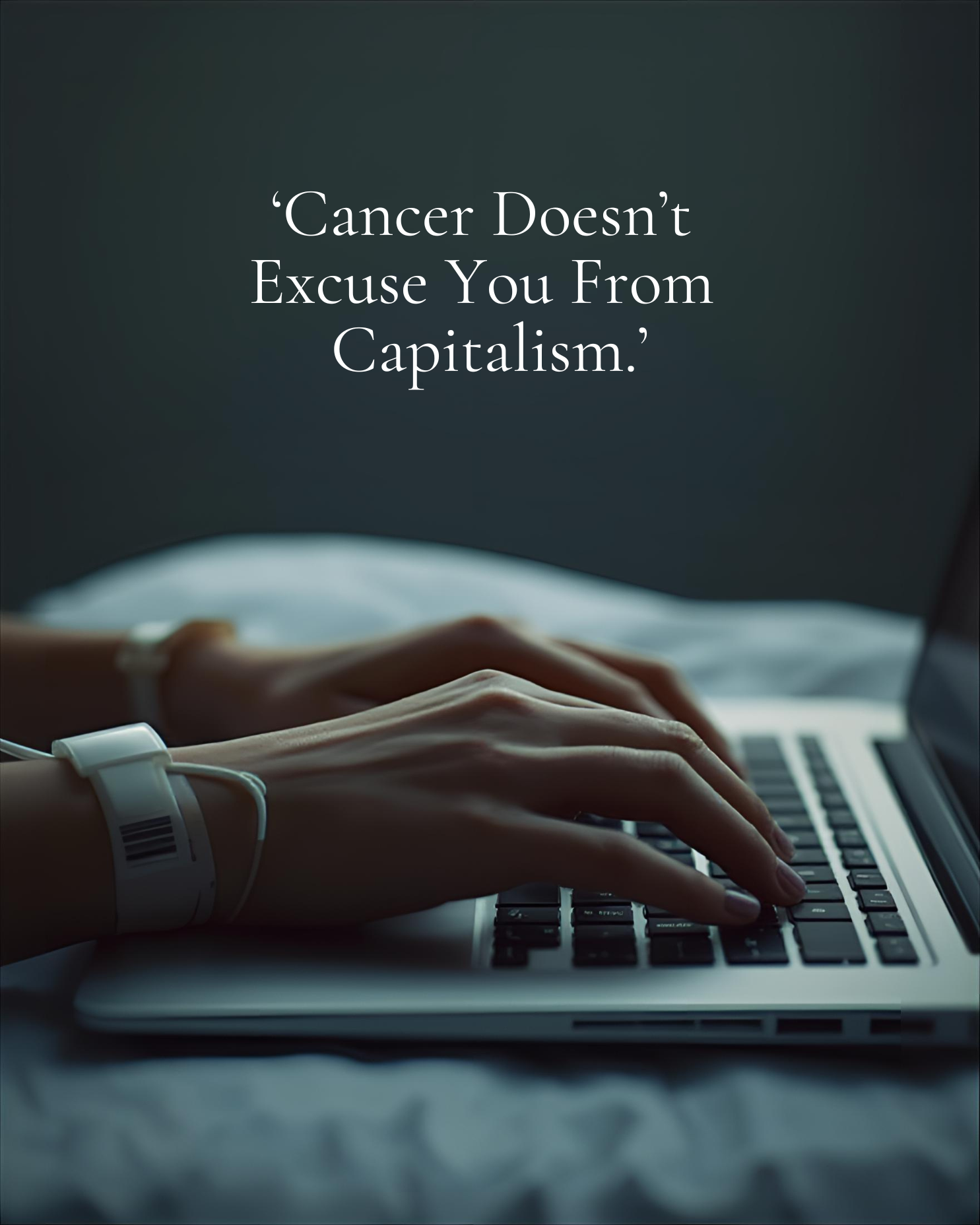
I am not the only one working through my chemo; there are thousands of people like me out there, showing up - to desks, to hospital corridors, to virtual meetings - trying to hold on to the illusion of normalcy. We have made a quiet deal with the system: you get my time, and I get to stay alive. But beneath that illusion lie deeper reasons. Some practical. Some are emotional—all human.
1. To Keep the Money Flowing (a.k.a. Financial Toxicity)
Chemotherapy doesn’t just drain your veins; it drains your bank account. There’s the loss of pay, the travel costs, the copays, the supplements your insurance doesn’t cover, and the side effects no one warns you will cost extra. The National Cancer Institute even has a term for it - financial toxicity. It sounds like a metaphor, but it’s literal: cancer can poison your finances as efficiently as your body. For many of us, working isn’t bravery; it’s a strategy to avoid bankruptcy.
2. To Keep Health Insurance — The “Job Lock”
Employer-sponsored insurance is both a blessing and a leash. If I quit, I lose my coverage. Simple. That’s called job lock: people stay in jobs not because they love them, but because leaving means risking their lives. I’m not passionate about corporate meetings; I’m passionate about staying insured.
3. To Feel Like Ourselves Again
When you stop working, the silence can become unbearable. Suddenly, every day is about your body, appointments, pills, side effects, the slow countdown to “five-year survival.” Work, in comparison, feels like borrowed normalcy, something that belongs to the version of you from before the diagnosis. For some of us, answering emails or attending meetings isn’t denial; it’s survival of another kind. A reminder that we still belong to the world of the living. Major cancer organizations even say that work can restore routine and balance, keeping distress from swallowing you whole.
4. Because the Law (Sometimes) Lets Us
In the U.S.A., there’s a small mercy—laws like the ADA and FMLA. They allow flexible hours, remote work, protected leave, and insurance continuity while you heal. That’s what makes it possible to keep working through chemo. I often think about what it would be like if I were still in India. There are no such protections there. I’d be relying on my family, my savings, and my guilt. They’d help me without blinking, of course, but I know how it would make me feel: powerless, indebted, and small. Here, I get to keep my job, my independence, and a fragile illusion of control.
5. Because It’s Easier Than Saying “I Need Help”
The most brutal truth is this: work gives us a script. It tells us what to do when everything else stops making sense. Showing up, even half-alive, feels easier than explaining what it’s like to fade in slow motion. It feels easier than depending on others or sitting still with fear. So we work. Because sometimes it’s not the spreadsheets we’re managing, it’s the chaos inside our heads.
So when someone asks, “Why are you still working?”, the answer isn’t simple. It’s part survival, part identity, part stubborn hope that life can still look normal — even when everything inside your body says otherwise.
Some people call it resilience — I call it paperwork. The truth is, working through chemotherapy isn’t a motivational story. It’s not about grit or hustle or proving a point. It’s about a system that makes healing conditional — a system that hands you an IV in one arm and a laptop in the other. People like me don’t keep working because we’re brave. We keep working because the cost of stopping is unbearable — financially, emotionally, existentially. Because we’ve learned that sickness has a subscription fee, and survival is billed monthly.